We show the government's numbers as published. Yearly pay is the hourly figure times 2,080 hours. Nothing is modelled or guessed. The U.S. comparison uses the national median for the same job code.
This page includes information from the O*NET 31.0 Database by the U.S. Department of Labor, Employment and Training Administration (USDOL/ETA). Used under the CC BY 4.0 license. O*NET® is a trademark of USDOL/ETA.
Content hash 6d841fb2 · first dealt Nov 16, 2026 · last changed Nov 16, 2026
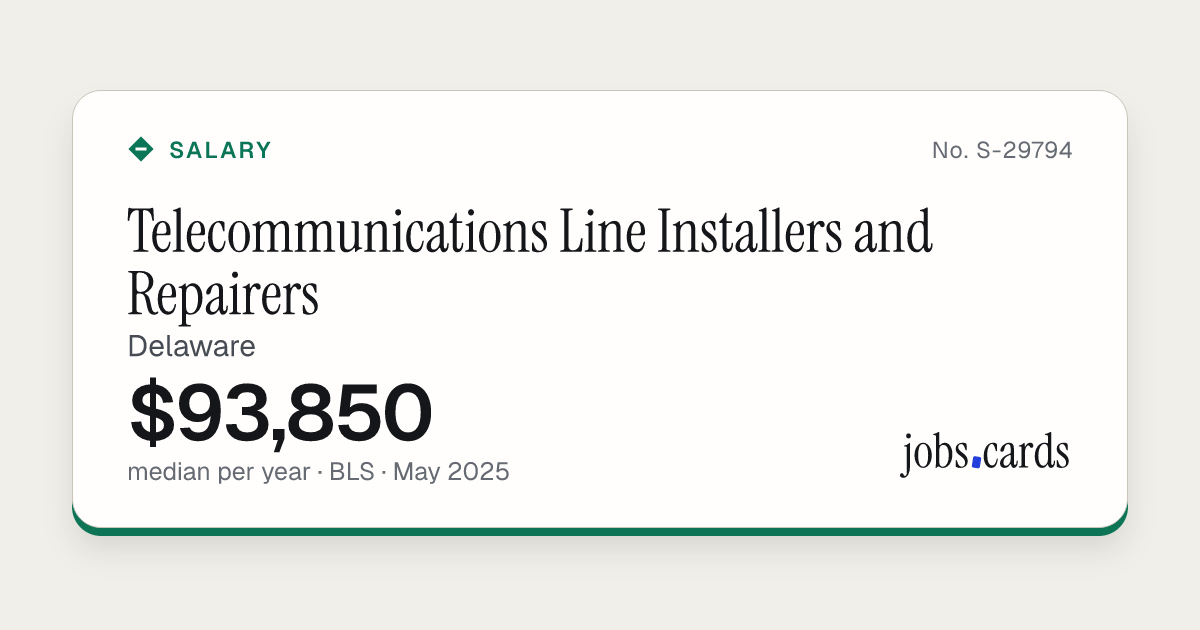
Telecommunications Line Installers and Repairers in Delaware earn a median of $93,850 a year, according to the U.S. Bureau of Labor Statistics survey for May 2025. Half earn between $60,610 and $98,140. The lowest-paid tenth earn under $38,370 and the highest-paid tenth earn over $98,580. These are government survey figures, not estimates from ads.
Checked Nov 16, 2026Source: U.S. Bureau of Labor Statistics
Reading the Numbers
Worked out from the published figures on this card. Nothing here is an estimate.
The median here is 26% above the national median of $74,330 for the same job.
Among the 50 states and territories where the Bureau of Labor Statistics publishes a reliable median for this job, Delaware ranks 9th by median pay. Rhode Island is highest at $103,810 and Puerto Rico lowest at $31,770.
310 people hold this job here, 0.3% of the 97,720 who hold it across the country.
Of every 1,000 jobs here, 0.64 are this job, about as common here as in the U.S. as a whole.
The middle half of workers earn between $60,610 and $98,140, a band $37,530 wide.
Pay at the 90th percentile ($98,580) is 2.6 times pay at the 10th ($38,370).
The average (mean) is $79,780, 15% below the median, so more of the spread lies on the low side.
By the hour, the published median is $45.12.
Delaware has enacted a law that will require pay in job ads from Sep 26, 2027. What Delaware’s rule says
Where This State Ranks
Its place among 50 states and territories, by median pay for this job.
What Telecommunications Line Installers and Repairers Do
Install and repair telecommunications cable, including fiber optics.
Common job titles: Cable Splicer, Cable Tech (Cable Technician), Cable TV Tech (Cable Television Technician), Combination Technician (Combination Tech), Fiber Optic Splicer, Field Service Technician, I and R Technician (Installation and Repair Technician), Installer, Outside Plant Technician (Outside Plant Tech), Telecommunications Technician (Telecommunications Tech).
What the Work Involves
The five tasks that workers and experts surveyed by O*NET rate most important for this job, most important first.
Splice cables, using hand tools, epoxy, or mechanical equipment.
Inspect or test lines or cables, recording and analyzing test results, to assess transmission characteristics and locate faults or malfunctions.
Clean or maintain tools or test equipment.
Set up service for customers, installing, connecting, testing, or adjusting equipment, such as digital subscriber line modems.
Travel to customers' premises to install, maintain, or repair audio and visual electronic reception equipment or accessories.
Education. 78% of workers surveyed by O*NET said the level required for this job is: High School Diploma or the equivalent.
Preparation This Job Usually Needs
Job Zone 1-2: Very Little to Some Preparation Needed. Usually requires a high school diploma or GED, though some occupations may not. Ranges from a few days to one year of on-the-job training. Some occupations may need little or no previous experience; others require several months to a year of experience. For example, landscaping and groundskeeping workers might require very little training or previous experience, while agricultural equipment operators can benefit from on-the job training.
This page includes information from the O*NET 31.0 Database by the U.S. Department of Labor, Employment and Training Administration (USDOL/ETA). Used under the CC BY 4.0 license. O*NET® is a trademark of USDOL/ETA.